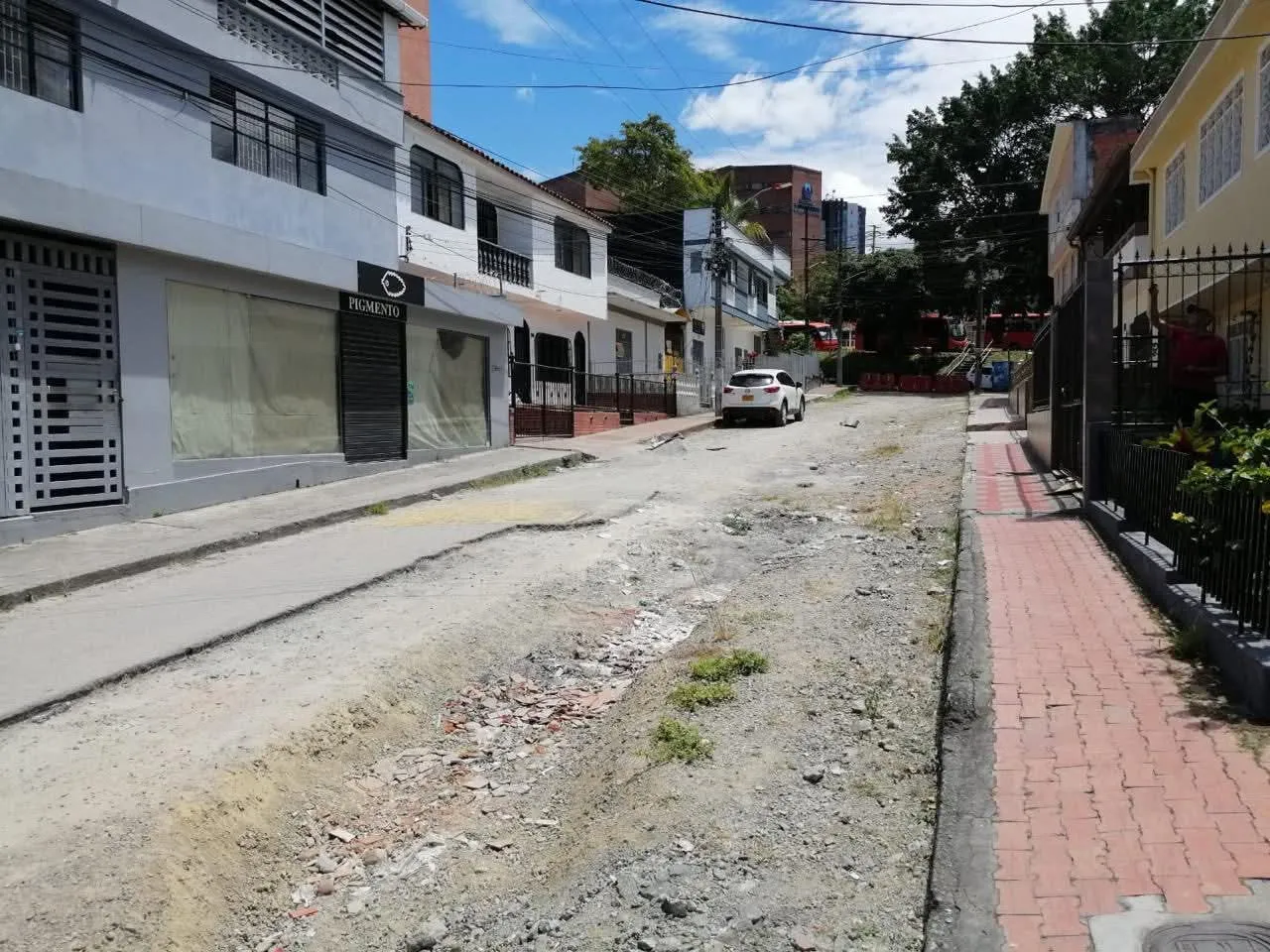
The failed road infrastructure project in Ibagué, known as the Calle 60 Bridge, has left a palpable trail of destruction in Barrio La Floresta, whose main alternate route, Calle 59, has had its pavement torn up and abandoned for nearly three years.
While Johana Aranda's administration celebrates the legal recovery of the $3.9 billion peso penalty imposed on the contractor, the affected community is demanding a firm start date for the repair of its road network and sewage system, pointing out that local economic and mobility impacts brook no further delays. The urgency remains high, posing a direct question to the municipal administration: How much longer will the ordeal caused by a project that was never even built continue?
The citizen complaint emerging from Barrio La Floresta is a stark testament to administrative and contractual inefficiency in Ibagué. Residents of Calle 59, which served as an alternate route for traffic diverted by the planned Calle 60 Bridge project, cry out that the street was left "destroyed because they tore up the pavement and have done nothing since." This abandonment has dragged on for nearly three years. The paradox of this project, infamous as the "Ghost Bridge," lies in the fact that, according to reports, it did not even reach the stage of becoming a "white elephant" because it "never even came to be" built. The physical ruin in La Floresta is not an outcome of halting the central structure, but rather of the "complementary works" required for utility relocation and traffic management. When the main contract was suspended, these preparatory tasks—which included digging up water/sewer networks and pavement—were left incomplete, turning the surrounding community into the primary collateral damage of the contractual breakdown. This demonstrates that poor planning impacted adjacent roads first and most severely, rather than the intended construction site, upending the logic of the promised benefits.
The root of this problem lies in Public Works Contract 1312, signed on April 19, 2023, between the Mayor's Office of Ibagué and Consorcio Puente Carrera Quinta. This contract, valued at over $39 billion pesos, was intended to carry out Phase 1 of the infrastructure. However, the project, initially scheduled for completion in December, faced multiple irregularities, including non-payment of workers and, crucially, the denial of the forestry management plan by Cortolima. The provisional suspension was formalized via an official record on January 23, 2024, for a 45-calendar-day period, citing that observations by the Secretariat of Mobility had disrupted projected execution timelines. The previous administration's initial defense, which argued a lack of permits from Cortolima and the Colombian Institute of Anthropology and History, indicates that the flaws leading to failure stemmed from initial planning rather than solely contractor execution. A project of this scale, lacking essential environmental permits and full clearance of mobility plans, was fundamentally flawed from the pre-contractual stage.
The sharpest impact of this contractual disaster has fallen on Barrio La Floresta, whose community became the quintessential victim. The primary damage is visible along Calle 59, described as "completely destroyed." Community leader Fabiola Peñaloza, president of the Community Action Board, detailed the grave consequences, noting that the street has been closed for "more than two years," cutting off the neighborhood and causing severe mobility issues. The economic impact has been equally catastrophic; Peñaloza stated that the local economy "has collapsed" and that "many businesses are closing" due to the prolonged road closure. In addition to commercial losses, residential infrastructure has also suffered; the community leader pointed out that while the street remains closed, their "homes are deteriorating." This case is notable because, rather than generating the anticipated economic boom, the mere anticipation and subsequent failure of the megaproject triggered an inverse economic slump and property devaluation, underscoring the vulnerability of urban ecosystems to poor public management.
Faced with the project's unfeasibility and repeated non-compliance, Mayor Johana Aranda's administration took decisive action to close the contractual cycle. Through Resolution 1400-1346 of June 4, 2024, the Mayor's Office declared the total breach of Contract 1312. As a legal consequence, a fine of $3,914,637,659 pesos was imposed on Consorcio Puente Carrera Quinta, equivalent to 10% of the total contract value. The mayor maintained that this action was fundamentally aimed at "protecting the public interest, safeguarding public funds," and halting potential damage to municipal finances. Declaring the total breach of a contract exceeding $39 billion pesos sets a precedent of rigor in Ibagué's contract management and sends a firm signal to future contractors regarding the serious consequences of negligence, marking a clear break from past practices of administrative permissiveness.
A crucial milestone in mitigating fiscal damage occurred on September 22, 2024. Mayor Aranda announced that the insurer Aseguradora Mundial transferred more than $3.9 billion pesos to the municipality. This financial move represented the effective recovery of the funds that had been provided as an advance to the contractor. The insurer's swift response, ruling in favor of the municipality and enabling the recovery of the funds within four months of the sanction, was highlighted by the administration. This achievement is fundamental, as it turns an inherited political and technical failure into a fiscal victory for the current administration. By recovering this capital, the Mayor's Office protects public resources and earns the legitimacy required to reallocate this money toward projects with an immediate impact on the quality of life of Ibagué residents. The mayor declared that this is "a key step toward safeguarding our city's resources."
The municipal administration has outlined the destination for the $3.914 billion pesos recovered from the fine. These funds will be reinvested in the renewal of water supply, sewage, and street paving across neighborhoods through the "Combo 3x1" program operated jointly with Ibal. This program aims to intervene in and rehabilitate 34 prioritized roads across the city. The mayor announced that an agreement with Ibal would be initiated the week following the announcement to launch these work packages. However, a critical disconnect arises between the fiscal success and the community's urgency: the list of 34 roads to be addressed has not explicitly confirmed the immediate inclusion of Calle 59 in Barrio La Floresta. If the community most affected by the contract's collapse—and on whose behalf these funds were recovered—is not among the primary beneficiaries of the restitution, the sense of administrative abandonment will persist despite the legal and fiscal progress achieved.
Beyond the penalty funds, the Mayor's Office of Ibagué has made a structural decision regarding the use of the original $40 billion peso loan. A formal request was submitted to the City Council to change the allocation of this capital. The new investment focus will be the comprehensive rehabilitation of Avenida Ambalá, specifically in the El Salado sector. This project spans approximately four kilometers and will include the replacement of water and sewage networks, complete road repaving, and the construction of sidewalks and curbs. The mayor justified this reallocation by the need to "prioritize mobility solutions for the city" and use the loan resources on a more pressing need, such as the deteriorated road network. This shift reflects a change in the investment paradigm, moving away from high-risk, focalized projects (the bridge) in favor of the urgent rehabilitation of existing arterial infrastructure, pointing toward a lower-risk management approach focused on systemic city maintenance.
The failure of the Calle 60 Bridge has provided a costly lesson for Ibagué, as well as a case study in fiscal and administrative responses to corruption. Although the Aranda administration has achieved significant legal and fiscal successes by recovering nearly $4 billion pesos and reallocating the loan toward more viable road projects, the true test of its administrative responsiveness lies in repairing local damage. The community of La Floresta has endured nearly three years of an economic and mobility "calvary." Fabiola Peñaloza's demand that the resources be used to maintain roads and sewage systems so that residents do not spend another December in "the dark" remains the most crucial metric of success. The administration's performance will not be measured solely by the billions reallocated on a macro scale, but by its concrete, prompt response to the question keeping public pressure on the Mayor's Office: "Until when, Mayor Johana Aranda?" Repairing Calle 59 is the unavoidable step for Ibagué to finally turn the page on the failed "Ghost Bridge."